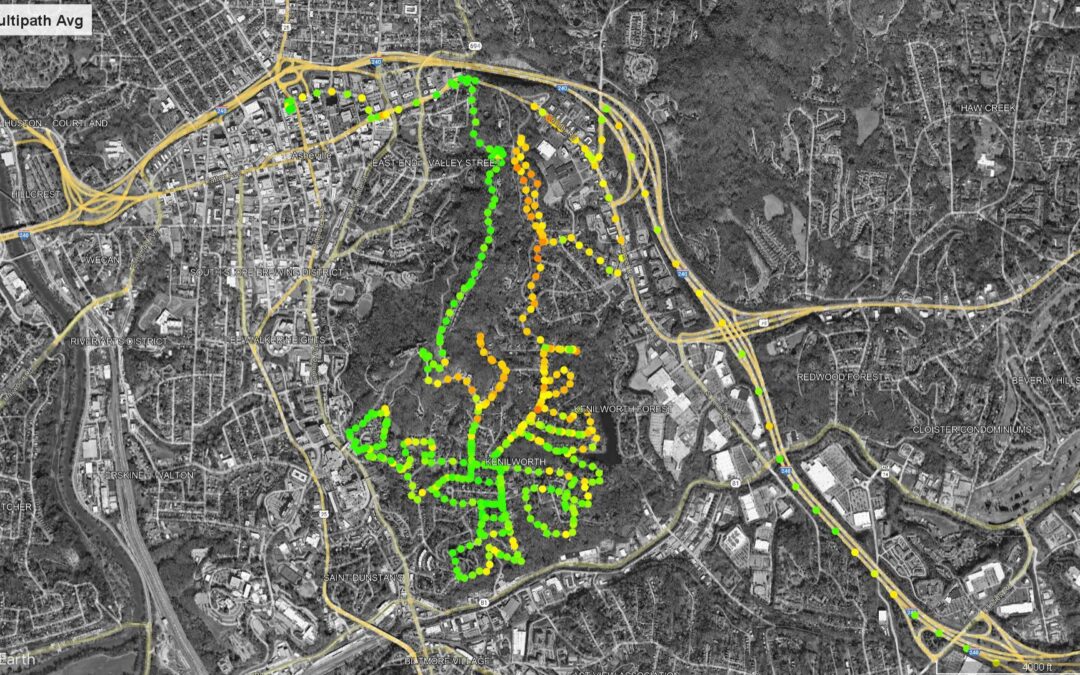
Over the past few weeks we’ve received several questions and concerns about reception in the Kenilworth area of Asheville. We have maps that mathematically model our approximate coverage and take into account our antenna height and terrain of broadcast area. This mathematical model is called Longley-Rice. These maps are accurate enough to tell where general reception trouble spots are due to terrain shielding.
FM radio signals are close to line of sight. There is a degree of bending they can do over and around mountains but broadly speaking they travel in a straight line. They are also absorbed or attenuated by nearly everything, most importantly in our area, earth. “Terrain shielding” is a somewhat self-explanatory term. You encounter this whenever there is a ridge, mountain, cliff, etc. between your location and a transmitter. This is an issue across our entire broadcast area.
Our maps indicate that the Kenilworth area should have more than adequate signal levels. But my gut instinct says there should be a noticeable decrease in signal, given the ridge between both 88.1 and 107.9 transmitter sites and the Kenilworth community.
To try and figure out what is going on here, I put a new piece of equipment to work. We recently got a mobile receiver, a Deva Radio Explorer, that allows us to log location data as well as multiple signal strength and quality measures. I mounted the antennas to the top of my car and went for a drive around as much of the Kenilworth area as I could. In hindsight I missed a few streets, but not being familiar with this particular area I came away with some useful data nonetheless.
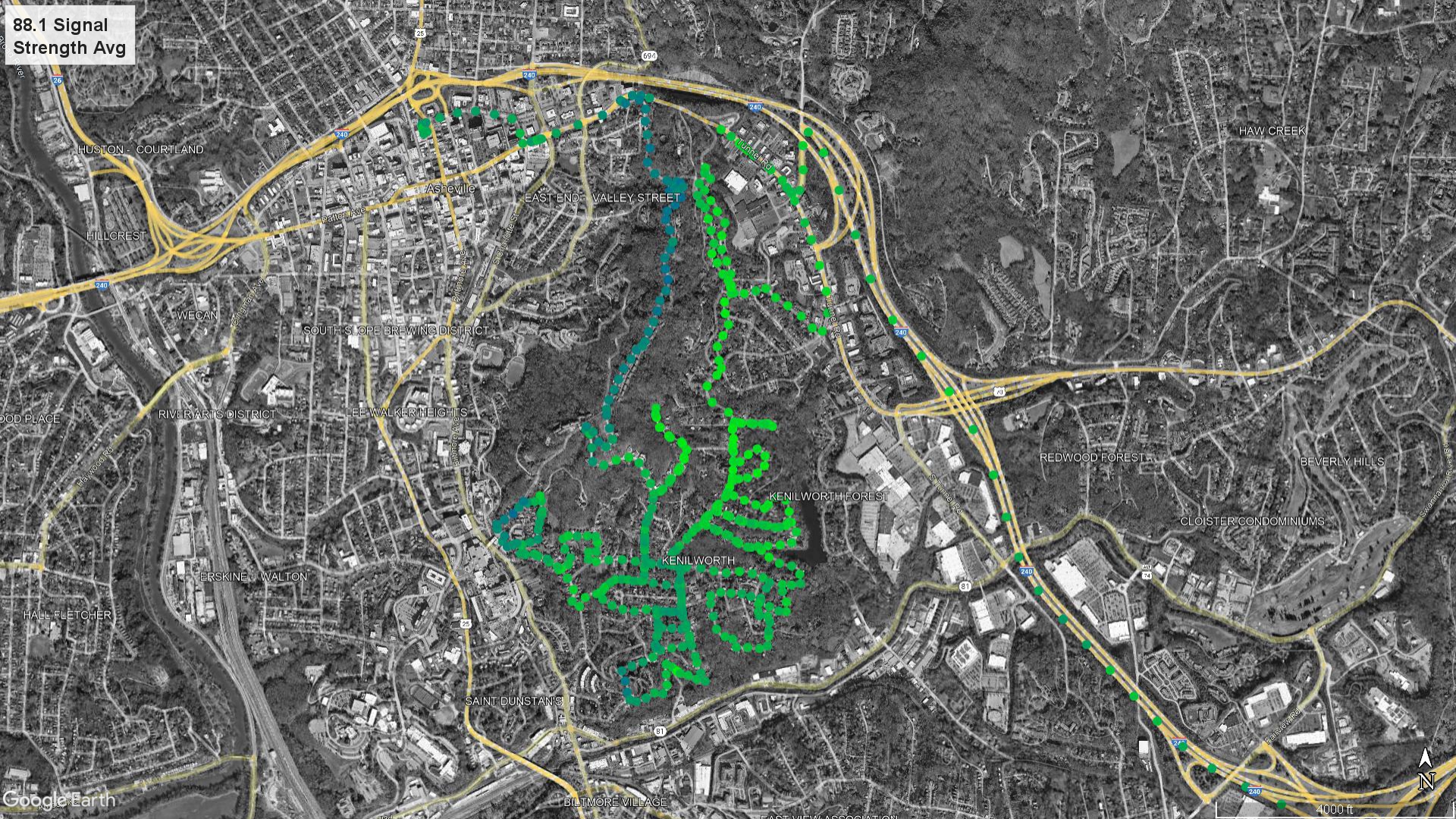
First, lets take a look at the 88.1 and 107.9 signal strength data:

Here’s a key for the signal strength color coding (higher value is better): 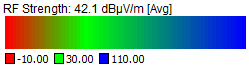
I left the station and headed down Tunnel Road. While the color coding isn’t the easiest to read, you can see that, for the most part, both 107.9 and 88.1 stay above the 30 dBu mark. It is worth noting that the signal strengths collected were from an antenna mounted on the top of my car. This is helpful to gauge where there are dips in signal strength, but does not consider how signals perform inside a building. Depending on the materials and construction style, along with many other factors, received signal strength can be much lower inside a building.
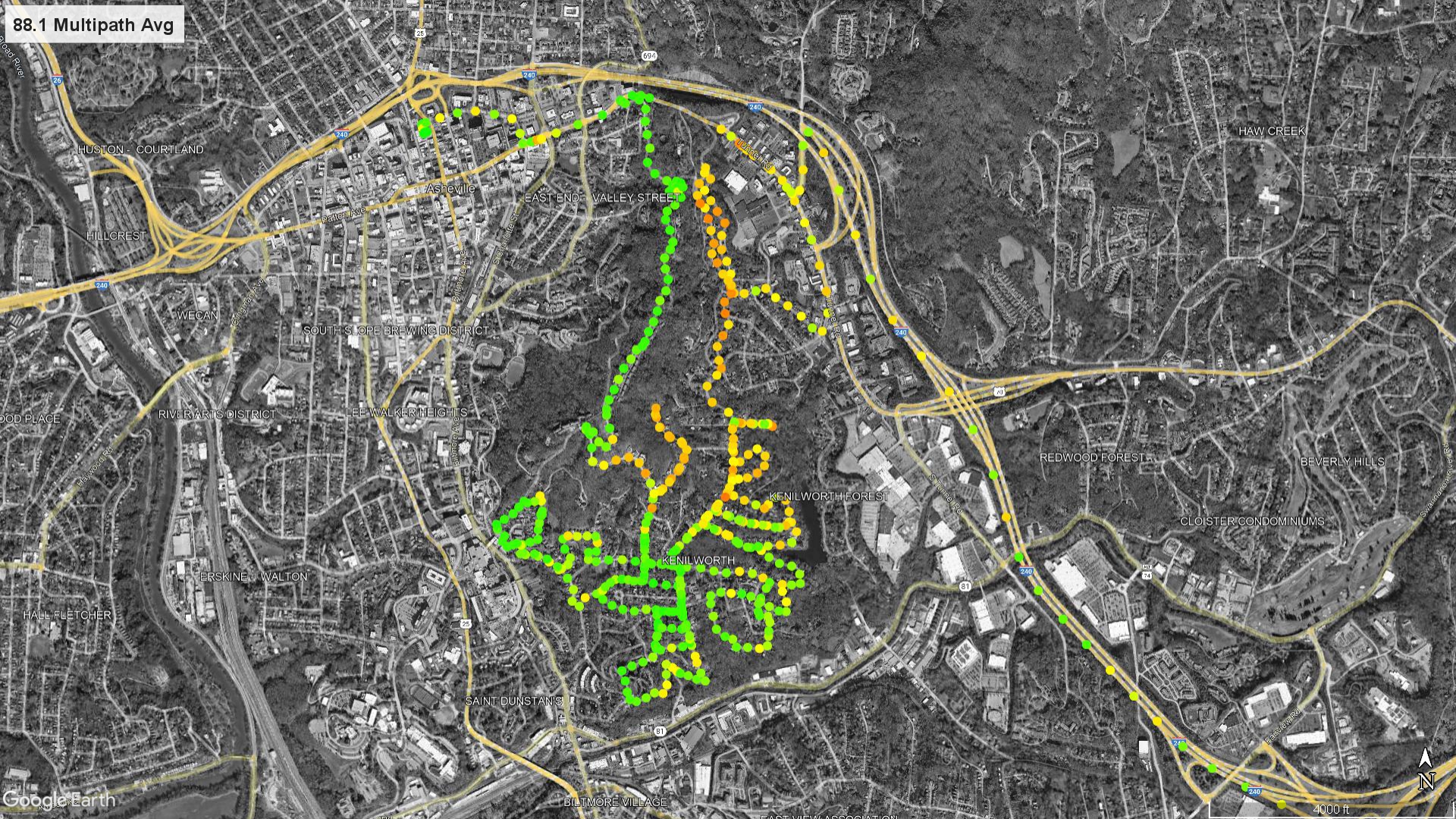
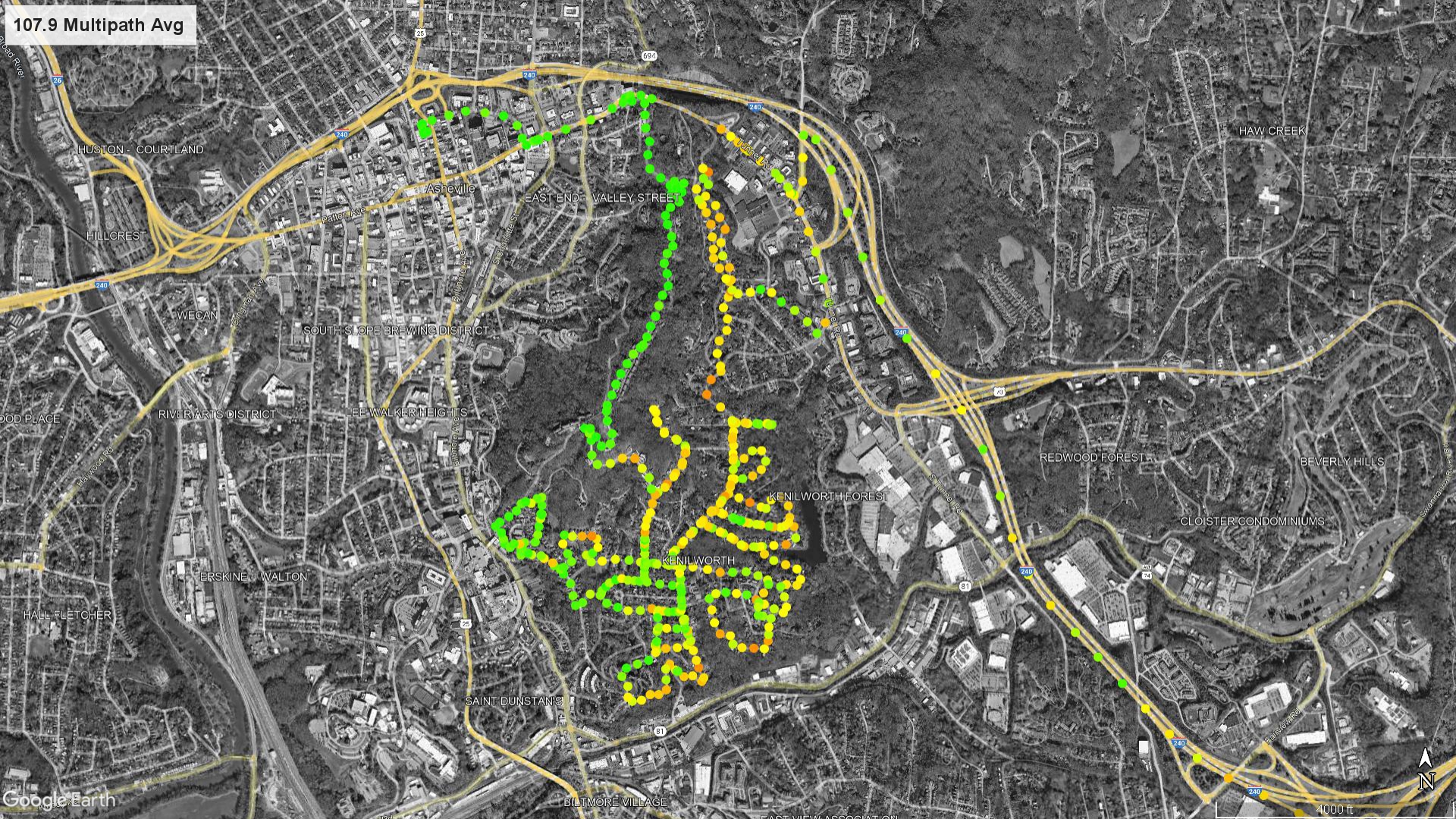
I then looked at the maps that logged multipath interference:
Color coding for the multipath maps (lower is better):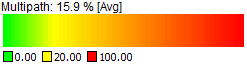
This is where things get tricky. When FM radio waves come into contact with terrain they are not completely absorbed. Some energy is absorbed but the rest is reflected and scattered back into space. This is what I believe is contributing to many reception issues in this area. When those bounced radio waves reach a receiver you can get what’s called multipath interference. These bounced signals arrive out of phase (at various times) with the main broadcast, and depending on how strong the primary signal is, how strong the bounced signal is, and the receiver you are using, it can range from a slight degradation in listening quality to completely wiping out the audio. Most receivers seem to start having noticeable issues when you get over 10-20% multipath interference.
Multipath interference can vary wildly within a few feet, and even while stationary in some situations. How it impacts your exact listening setup also greatly depends on your building construction, antenna, and receiver. Some receivers are better able to filter out those reflected signals, and an omnidirectional antenna would be more susceptible than a directional one.
My theory is that both 88.1 and 107.9 are funneling through the cut in the ridge for 240 and scattering off the face just north of the 240 – Tunnel Rd intersection complex. This is introducing a lot of possibilities for multipath interference until you get to the very southern end of the area by Swannanoa River Road.
There’s unfortunately nothing we can do as a broadcaster to mitigate multipath interference. I can offer some of our usual suggestions to improve reception in less than ideal areas. Outside antennas will always give you the best chance and picking up the strongest and cleanest signal. Adding an external antenna to your radio would be the next best thing. To go along with that, keep radios near windows or as close to the exterior of home as possible. Experimenting with antenna positioning can often yield good results — sometimes not extending telescoping antennas to their full length works better for some frequencies, or rotating them 90 degrees to horizontal works better in some cases. As always, keeping power cords away from antennas is preferable.
For frequency lists, coverage maps, and more details on BPR’s Big Switch visit bpr.org/bigswitch. If you have additional questions about this blog post or your reception, email tech@bpr.org.
